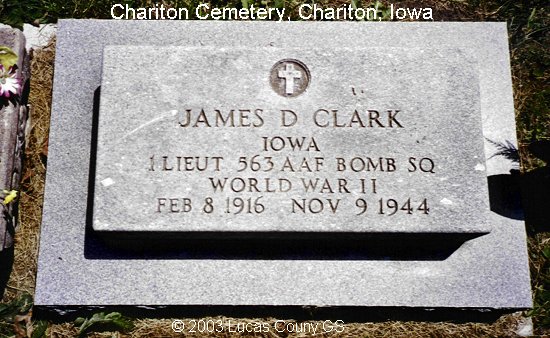
First Lieutenant James Duane Clark
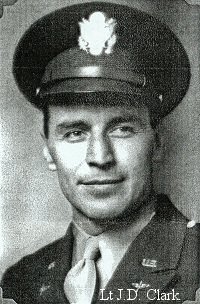 |
World War II US Army Air Forces
563rd Bomb Squadron, 3rd
Bombardment Division, 8th Air Force
Service Number: O-824097
Born:
February 8, 1916
Inducted: February 23, 1943 - Iowa
Killed in action
November 9, 1944 over Belgium
Buried: Chariton Cemetery, Section K, Row 5,
Lot 69
Chariton, Iowa
Distinguished Flying Cross, Air Medal w/4 OLC, Purple Heart |
Husband of Maxine Sutton Clark of Akron, later of Denver. Son of Melvin R.
and Mabel D. Clark of Chariton, Iowa.
A brother, PFC Beryl L. Clark, 357th
Inf Reg, 90th Inf Div, who was killed in action Jan 11, 1945, is buried beside
James.
June 5, 1943, Chariton, Iowa
James Duane Clark, son of Mr. and Mrs. Melvin R. Clark, Chariton, has been
enrolled in the school for pilots at Maxwell field, Alabama.
Clark is a graduate of the Chariton high school and was a structural steel
worker and rigger when he entered the army Feb 23, 1943. He served as an
enlisted man until he was accepted as an aviation cadet.
November 18, 1943, Chariton, Iowa
Aviation Cadet James D. Clark, son of Mr. and Mrs. Melvin R. Clark, recently
reported to the Greenville Army Airfield, Greenville, Miss., for further flight
training.
February 12, 1944, Chariton, Iowa
Clark Wins Wings at Illinois Field
Son of Mr.
and Mrs. Clark Now Lieutenant in Army Air Corps.
Lt. James D. Clark, son of Mr. and Mrs. M. Clark of Chariton, was a member
of the 44-B class of aviation cadets to graduate from the Army Air Forces Pilot
School (Advanced 2 Engine) at George Field, Ill., Tuesday.
He received the silver wings of a flying officer and was commissioned a
second lieutenant.
Lieutenant Clark entered pilot training last June and attended schools at
Americus, Ga., and Greenville, Miss., before going to George Field.
He attended high school in Chariton and was with the Selmes Drake
Construction Co. in Seattle Wash. before entering service.
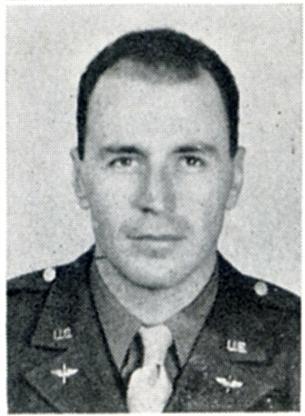
August 24, 1944, Chariton, Iowa
Lieut. J.D. Clark Co-Pilot of Flying Fortress Over
Reich
Crippled by Enemy Fire; Battles Way Home by Itself
An Eighth Air Force Bomber Station, England -- Flak that ripped open
a fuel tank and punctured an oil cooler, dropped the B-17 Flying Fortress
piloted by 2nd Lieutenant John J. Chimenti, 23, of Erie, Pa., flying
his fifth bombing attack, out of formation but he brought his plane home
safely on three engines alone.
The target was the Krupp armament works at a Magdeburg, and Lt. Chimenti
held his stricken plane in formation until bombs away. Then he fell back.
The tank that serves the number 4 engine had been torn open. The gas came
out in a solid stream. The pilot stopped the engine and transferred all the gas
which could be saved to the other three engines.
Flying alone across Germany, the crew expected to be pounced on by enemy
fighters, but they were not attacked. The co-pilot, 2nd Lieutenant James D.
Clark, 28, of Chariton, Iowa, reported seeing German fighter planes in the
vicinity but they failed to close in on the crippled bomber.
Lt. Chimenti's squadron is part of a group attached to the 3rd Bombardment
Division, which has been cited by the president for the now historic North
Africa shuttle attack, when Messerschmitt plants at Regensburg, Germany were
attacked.
Lt. J.D. Clark Awarded Cluster
Decorated for
Work In Support of Army.
An Eighth Air Force Bomber Station, England -- Two Southeastern Iowa men
have been decorated with the Air Medal, or with an Oak Leaf Cluster to an Air
Medal previously awarded, at the Eighth Air Force B-17 Flying Fortress station
by Colonel William B. David of Calhoun, Ga.
They are:
Second Lieutenant James D. Clark, 28, of Chariton, who has been
awarded the Air Medal. He is the son of Mr. and Mrs. Melvin R. Clark and his
wife is Mrs. Barbara M. Clark of Denver, Colo. He was a structural steel worker
at Seattle, Wash., before entering the AAF in February, 1943.
Staff Sergeant Paul W. Rheinschmidt, 19, of Burlington, tail gunner, who has
been awarded an Oak Leaf Cluster to his Air Medal, equivalent to another award
of the medal.
The men were decorated for "meritorious achievement" during bombing attacks
on Nazi war industries and on military targets in France in support of Allied
ground forces.
Their group is a unit of the 3rd Bombardment Division, cited by the
president for its now historic England-Africa shuttle bombing of the
Messerschmitt aircraft factories at Regensburg, Germany.
October 31, 1944, Chariton, Iowa
Promotion to James D. Clark
An Eighth Air Force Bomber Station, England -- Promotion of James D. Clark,
28, of Chariton, Iowa, from second to first lieutenant has been announced by
this Eighth Air Force station.
Lieutenant Clark is co-pilot of a B-17 Flying Fortress that has been bombing
Nazi war industries and military targets in support of Allied ground
forces.
He is the son of Mr. and Mrs. M.R. Clark and his wife is Mrs. Barbara M.
Clark of Denver, Colo. Before entering the Army Air Forces in December 1942
(sic), he was an employee of the Selmes Drake Construction Company of Seattle,
Wash.
November 23, 1944. Chariton, Iowa
Lt. Duane Clark Killed in Action Over
France
Parents Notified Death Occurred on Thursday, Nov.
9.
First Lieut. J. Duane Clark, 28, son of Mr. and Mrs. Melvin Clark, Chariton,
has been killed in action over France. This word was received by the parents
Sunday evening in a telegram from the government.
Lieut. Clark was a pilot of a B-17 Flying Fortress and was with the 8th air
force now seeing action on the western front.
He was graduated from Chariton high school in 1933 and from there went to
Cleveland, Ohio, where he learned the welding trade. He worked at various
places in Cleveland until the time war broke out when he was sent to Dutch
Harbor, Alaska, where he worked on defense construction until he enlisted in
the army in February, 1942. (sic)
Following his enlistment he was sent to officers' training school and took
pilot training, being graduated from this work with the rank of lieutenant of
February 8, 1943 (sic). He took his work at George Field Ill. and advanced
training in Florida.
His wife, Mrs. Barbara Clark, to whom he was married Feb. 16, 1944, is
living with her parents in Denver, Colo. She is engaged in war work. A brother,
Pfc Veryl Clark (sic) is now in action on the French front.
November 31, 1944, Chariton, Iowa
Gives Life
(Photo)
First Lieutenant Duane Clark, son of Mr. and Mrs. Melvin Clark, Chariton,
who was officially reported killed in action over France. Lt. Clark was a pilot
of a B-17 Flying Fortress. The war department lists November 9 as the day he
was lost.
Mrs. Barbara Clark, of Denver, widow of First Lt. Dwaine Clarke (sic), who
was killed in air corps service over France November 9, 1944, returned to
Denver Saturday after spending a week here with her husband's parents, Mr. and
Mrs. Melvin Clark and sister, Dortha Clark. She was accompanied to Denver by
Mrs. Clark, who will visit relatives.
Thursday December 7, 1944 The Akron News-Reporter
Lieut. James Clark Killed in Action
First Lieut. James D. Clark, husband of Maxine Sutton Clark, was killed in
action over France, November 9, according to word received November 26. A
letter of confirmation from the war department was received Dec 3 by Mrs.
Clark.
Lieut. Clark was a pilot of a B-17 Flying Fortress and was with the Eighth
Air Force now in action on the western front. He had been awarded the
Distinguished Flying Cross, the Air Medal with four Oak Leaf Clusters, and his
group was a unit of the 3rd Bombardment division, which was cited by the
president.
Going overseas last June, Lieut. Clark had only four more missions to
complete for the required number in that theater of war.
No further details of the tragedy were available, but no doubt in time more
information will be released.
Lieut. Clark was the son of Mr. and Mrs. Melvin Clark of Chariton, Ia. and
his wife is living with her parents, Mr. and Mrs. Jack A. Sutton in
Denver.
August 1948, Chariton, Iowa
Services Sunday For Clark Brothers
(Beryl Lowell
Clark photo and James Duane Clark photo)
Double military funeral services for James Duane and Beryl Lowell, sons of
Mr. and Mrs. Melvin Clark, whose bodies were returned from overseas Tuesday to
Chariton, will be held at the Dunshee Funeral Home, Sunday, Aug. 29.
Officiating will be the Rev. Archie Beals and the Rev. Virgil __anson. Burial
will be in the Chariton cemetery and the American Legion will be in charge of
the graveside services. Serving as casket bearers will be boyhood friends of
the Clark brothers who have all served in different branches of the service.
(List omitted)
Beryl Lowell Clark
(most of the edge of newspaper column cut off
so this obit omitted)
James Duane Clark
James Duane, eldest son of Melvin and Mabel Clark, was bon in Lucas county,
February 8, 1916. When a small lad he united with the Presbyterian church of
Chariton. He was graduated from the Chariton high school with the class of 1933
and later from the Lincoln Welding school of Cleveland, Ohio, where he was
employed for a number of years. Prior to his enlistment in the service of his
country, he worked on government defense construction at Dutch Harbor, Alaska,
and was there when the first bombing by Japan took place there.
Returning home late in 1942, he enlisted in the army air corps and entered
pilot training in 1943, being graduated with the rank of Lieutenant on Feb. 8,
1944, at George Field, Ill. On Feb. 16, 1944 he was united in marriage to
Barbara Maxine Sutton, who was a faithful companion to him during further
advanced training in Florida. On June 15, 1944, he was sent overseas to the 8th
Air Force in England where he served as a co-pilot on a B-17 bomber. While
participating in his 33rd mission to Saarbrucken, Germany, his plane exploded
in mid air and he was called to rest Nov 9, 1944. Seven of his crew parachuted
to safety and they said, ":Duane gave his life for us." By direction of the
President he was awarded the Distinguished Flying Cross, Air Medal and four Oak
Leaf Clusters, posthumously.
After entering the service Duane renewed his covenant with Christ and his
letters to his loved ones bear witness of his steadfast faith in Him.
One brother, Paul, preceded him in death in July, 1927. He is survived by
his wife, Barbara, Denver, Colo., his father, mother and one sister, Dortha
Sandahl, all of Chariton. His brother Beryl, was killed two months
later.
Gaston Georges of Belgium provided the following information:
United States Army Air
Forces - 8th Air Force - 3rd
Bombardment Division - 45th
Combat Bombardment Wing -
388th Bombardment Group -
563rd Bombardment Squadron.
On November 9, 1944, the
B-17G "Cicero Kid" #
42-97101 took off at Station
136, Knettishall, England.
The target of mission 223
was the Marshalling Yards
and rail facilities of
Saarbrucken, Germany. It was
the 33rd mission of the
crew. The plane was over
Fouches (a small village
south-east of Belgium) and
was approaching the I. P.
for the start of the bomb
run when engine # 4 caught
fire. Simultaneously a
violent explosion broke the
plane into three parts. The
pilot and the co-pilot were
apparently fatally injured
in the explosion and
perished in the wreckage.
John J. Chimenti is buried
in Erie, PA, and James D.
Clark is buried in Chariton
IA. The other seven crewmen
parachuted to safety. Two
of the five bombs exploded
when they hit the ground.
One destroyed a building and
killed the owner, Germaine
Thomas.
This information was given
to me by William M. Foster,
navigator aboard the "Cicero
Kid", when he came back to
Fouches on June 3, 2000.
William Foster died and was
buried in Auburn, NY, in
2007.
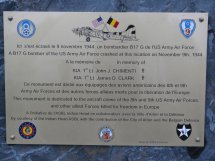
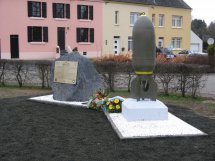
On December 12, 2009, a
memorial site was
inaugurated by Indian Head
(Belgium Military Vehicle
Conservation Group) at the
commemoration of the 65th
anniversary of the Battle of
the Bulge. The monument is
located in Fouches, Belgium,
and is dedicated to all
aircraft crews of the 8th
and 9th US Army Air Forces,
who served to liberate
Europe during WW2. This
memorial is also dedicated
to the memory of 1st Lt.
John J. Chimenti and 1st Lt.
James D. Clark who were KIA
aboard the B-17 "Cicero
Kid".
|
|
|
Credits:
Headstone photograph donated by the Lucas County (Iowa) Genealogical
Society.
1944 class photo scan donated by Paul Roales
Clark photograph and Chariton news clippings donated by Reta William.
Belgium plaque and memorial photo donated by Gaston Georges
Go to prev page | next
page.
Return to Gold Star Veterans Index.